
5 Tips to Choose the Right Book Size for Your Genre
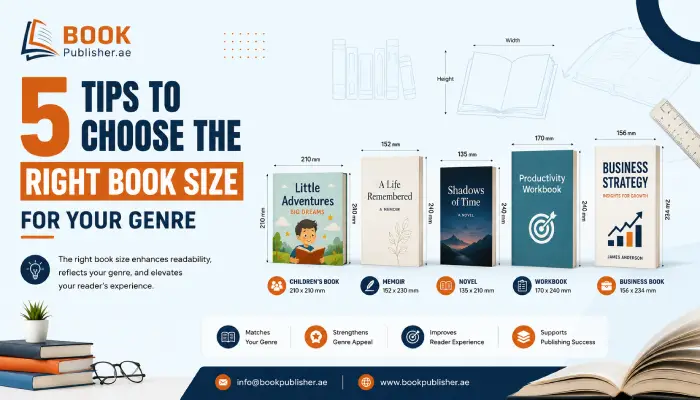
Writing is indeed an uphill battle. But let’s be honest, it is still easier than the lengthy and demanding publication process, right? Before publishing your book, you have to make a lot of decisions. Your book cover, font, plot, and book size all matter equally. Most authors ignore the size of their book until publication. However, you must remember that your book’s size not only influences production costs but also the reader’s comfort and portability. Hence, choosing the right book size is not an option, but a necessity.
In this blog, we will share five powerful tips to help you choose the right book size based on your genre. So, what are we waiting for? Let’s dive in!
Why Does the Size of a Book Even Matter?
Before moving on to choosing the right size of the book, let’s first understand why it even matters.
Choosing the right book size is one of the most important decisions in the book publishing process. It influences the production and shipping costs, affects the reader’s perceived value, and impacts readability and portability. In addition to this, it matters for your book’s genre as well as marketability.
Production and Shipping Costs:
First and foremost, the trim size directly influences the production and shipping costs. The larger the book, the more paper it requires. Not only this, but these books also weigh more and have higher shipping costs.
These increased production costs directly affect royalty rates and retail pricing. On the other hand, smaller books are generally more cost-effective. They are not only more economical to print than larger books but also weigh less and have lower shipping costs.
Reader’s Perceived Value:
Besides that, larger books have a substantial page count, which can suggest a higher value of your book. This can justify a higher retail price and may increase potential earnings per sale. On the contrary, readers perceive smaller books as lighter reads. Hence, they expect lower prices.
Readability and Portability:
Readability and functionality matter a lot for readers. Larger trim sizes offer wide margins, larger fonts, and better display of images, which enhances the readability of your book.
On the flip side, smaller trim sizes are easy to hold and carry.
Book’s Genre:
Different genres basically have different standard sizes. Fiction books favour small sizes for portability, such as 4.25″ x 6.87″. Whereas non-fiction, textbooks, and art books mostly use larger formats, such as 6″ x 9″ or 8.5″ x 11″.
Marketability:
The size and visual appeal of your book help it stand out in the marketplace. In addition to this, maintaining the same book size across a series helps with your branding. This way, your target audience can easily recognise your book among competing titles.
5 Tips to Pick the Right Book Size for Your Genre
Now let’s explore how to choose the right trim size for your genre. Some powerful tips for choosing the correct book size for your genre are as follows:
Research Your Genre’s Standards:
First and foremost, you must research your genre’s standards. You can visit some bookstores, or just open Amazon KDP. This will help you get an idea of the trim sizes of different genres.
These are some examples of standard trim sizes in the UAE:
Fiction (Romance, Thriller, Sci-Fi):
5″ x 8″ or 5.5″ x 8.5″
Memoirs and Business:
6″ x 9″
Children’s Books:
8.5″ x 8.5″ or 7″ x 10″ (standard for illustrations)
Poetry:
5″ x 8″ or 6″ x 9″
Academic/Textbooks:
6″ × 9″ or 7″ × 10″
Workbook/Journal:
6″ × 9″ or 8.5″ × 11″
Cookbook:
8″ × 10″ or 8.5″ × 11″
Art and Photography:
8.5″ × 11″
Estimate Your Page Count:
The number of pages plays a crucial role in managing your publishing cost. Besides that, it also influences the physical size of your book.
For books less than 100 pages, you can use a smaller trim size, such as 5″ × 8″ or 5.5″ × 8.5″. This will prevent the book from looking too thin or flimsy.
On the other hand, for long books (more than 400 pages), you can use a larger trim size, 6″ × 9″ or 7″ × 10″.
Consider Your Content and Visuals:
In addition to this, you need to consider your content type (text and visuals). The density of your content must dictate your book size.
For books that are heavily based on text, you can use A5 or 5.5″ × 8.5″. This will improve readability and enhance reader comfort.
However, for image-based books, you can consider larger formats, such as A4 or 8.5″ × 11″. This makes your book look less cluttered and gives it a more professional appearance. Many art book publishers prefer larger trim sizes, such as A4 or 8.5″ × 11″, to showcase images more effectively.
Optimise for Cost:
Using standard sizes, such as A4, A5, and 6″ × 9″, helps you save money. This allows local UAE printers to maximise paper usage. This not only reduces waste but also lowers your per-unit cost.
However, using custom or non-standard trim sizes usually requires special handling. This can significantly increase your printing costs.
Order a Proof Copy:
Finally, before finalising your book, you should order a physical proof copy of your book. This will allow you to check for readability, margins, and the book’s feel.
How do you choose the size of your book?
Choosing the size of your book primarily depends on your book’s genre, word count, and production costs.
What are some tips for picking the right trim size for your genre?
The following are the tips to pick the right trim size for your genre:
Research your genre’s standards
Consider your content and visuals
Estimate your word count
Prioritise the reader’s comfort and portability
Order a proof copy
What is the cheapest book size to print?
The cheapest book sizes to print are A5, 5″ x 8″, or 5.5″ x 8.5″.
Make the Best Choice!
Now is the time to make the best choice!
Picking the right book size is pretty crucial before the publishing process. It not only affects your book’s production costs but also its marketability and overall reading experience. However, you must remember that different genres have different trim sizes. So, you have to pick your book’s size, depending on your genre.
These are 5 tips that you can follow to choose the ideal trim size:
- Research your genre’s standards
- Consider your content and visuals
- Estimate your word count
- Prioritise the reader’s comfort and portability
- Order a proof copy
Best of luck with your publication!

I am a literary consultant and publishing strategist with over a decade of experience in the UAE’s vibrant book industry. I specialize in helping Emirati authors navigate the complexities of self-publishing, from fine-tuning manuscripts to mastering Amazon distribution. With a passion for transforming drafts into bestsellers, I provide actionable insights through my blogs for poets, novelists, and academic researchers looking to leave a lasting legacy.