
Why Print On Demand Beats Traditional Book Printing
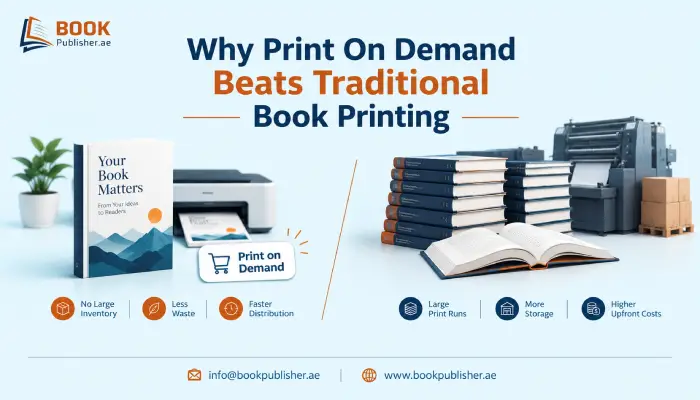
Discover the reasons why Print on demand is popular in comparison to the traditional method of book printing. Analyse how manufacturing flexibility, minimal waste generation, lower storage requirements, and efficient distribution make it an effective publishing process.
Make Distribution Simpler For Independent Authors
In the past, the publication of a book involved making a big decision even before the first copy was received by the reader. The writer had to gauge the demand for their book and then decide on printing many copies, store them, and hope that they would be sold eventually.
Print on demand is a totally new way of doing things. There is no need to produce huge stocks in advance since the copies can be made only upon demand. This increases the control of the author regarding how many copies are made and minimises the risks involved in conventional manufacturing.
The benefit is particularly significant to self-publishing authors and small publishing firms which might lack sufficient storage space and budget for conventional printing.
Reduce Upfront Costs Without Large Print Runs
A lot of traditional book printing companies demand a relatively large order volume to start book manufacturing. The larger the order, the more money the author or publisher has to invest before understanding the selling potential of the book.
The print on demand technology makes it possible to create a relatively small volume of books when a customer orders. It means that a large initial capital investment is not needed anymore.
It is especially convenient for first-time authors who can allocate their money to editing, cover design, advertising, and distribution instead.
However, it does not mean that all Print on demand books will become cheaper than traditionally printed ones in bulk. The primary benefit of print on demand is the control over investments and inventory.
Keep Publishing Flexible As Demand Changes
Reader demand does not always stay constant. Reader demand might rise immediately after a new book comes out and then level off at lower rates.
The traditional method of printing books might make it more difficult to cope with changing reader demand since a certain number of books could have already been printed by that time. On-demand printing allows one to print only when an order comes.
The book will keep on being sold even when there is low demand. Later on, when the demand becomes higher due to media coverage or recommendation, more books will be printed.
For a book publisher UAE, such versatility would prove beneficial when catering to various clients without the need for excessive physical inventory.
Make New Editions Easier To Manage
Revisions are sometimes needed on books even after they have been published. This may include the correction of an error, updating some information, revising some sections, or redesigning the cover.
Using traditional printing methods, revisions can be costly when thousands of copies have been printed. Even if revisions are made on newer prints, existing stocks can still have the previous printings.
The print on demand technique can help reduce the difficulties brought about by revisions since new copies will use the revised files. Proofreading is very important before the book is published, even if revisions become easier through Print on demand.
Test Reader Interest With Less Risk
The author does not know the exact number of readers that will purchase the book, and placing an order for thousands of copies without demand can cause extra financial pressure.
In print on demand, the book comes into the market without necessarily having a huge stock to begin with. This allows the author more time to analyse the demand and work on their marketing according to results.
In case the demand is low, then there won’t be much unsold stock to deal with. When the demand is high, more books can be printed based on orders. This makes Print on demand ideal for niche topics, specialist books, new authors, and uncertain demand situations.
Make Local Printing More Convenient
With conventional printing, the process could include planning for minimum order quantity, scheduling, and logistics for shipping and storing the books. This process may get complicated when a small order is requested by a publisher.
Print on demand technology makes the publication process easier even for small orders. In the UAE, writers can explore the options of using local printers when the need arises for physical copies.
Book printing Dubai services can be quite helpful when there is a need for local manufacturing, as it would make things much more accessible and convenient.
Give Independent Authors More Control
Conventional publishing usually consists of many steps and decisions made either by the publishers or their printing associates. Print on demand allows independent writers more freedom in managing the process of production and distribution.
This includes having control over the final product in terms of the manuscript, cover, price, distribution method, and revisions as per the chosen publishing approach.
It doesn’t mean that an author must do everything personally. Professional editors, designers, printers, distributors, and marketers can still be hired.
Compare Print On Demand With Traditional Printing
The major distinction lies in the planning process.
Traditional printing might be better for cases where the demand is predictable, and the required quantity is high. The unit cost will be lowered through a greater print run if the number of sold items is high enough.
Print on demand might be preferred if there is a need for higher flexibility, reduced inventory, and lower initial commitment. It is especially good for unpredictable or low demand.
Make The Publishing Process More Adaptable
The present-day author needs versatile publishing options that can accommodate changes such as the readers’ requirements, effectiveness of the marketing campaign, updates in the book, and the sales platform itself once the book is released.
With print on demand, authors will have more flexibility in adapting to these shifting conditions without having to stockpile a large inventory of books.
This kind of publishing can also become more accessible to those who are trying out their first book or creating a small collection of books. This solution works best in conjunction with good editing, cover design, book data, pricing, and marketing strategy.
FAQs
Is Print on demand better than conventional printing?
Print on demand gives more flexibility, reduced print volumes, cheaper upfront costs of keeping inventory, and easy access in the long term. Traditional printing may be preferred by publishers if the order is large enough and producing many copies is profitable from a cost perspective.
Are print on demand books printed individually when an order is placed?
No, it is possible to produce the required quantity of books based on demand, but there might also be an opportunity to place larger orders. The key difference is the need to pre-order a large amount of books before selling them.
Is Print on demand good for new authors?
Yes, the process is appropriate for new authors as it will help them avoid buying many copies without knowing how much interest they will create in the readers’ community.
Can I revise a Print on demand book?
Yes, if a provider permits updating files, then an author can send a new manuscript or cover file to be used for all books to be printed in the future. It is necessary for an author to find out the conditions for revision beforehand.
Does print on demand reduce wastage of books?
Yes, print on demand decreases wastage caused by overproduction of books. Nevertheless, the entire effect on the environment may be evaluated considering many factors such as materials used and printing processes.
Conclusion
Print on demand has affected the attitude of self-publishing authors and small publishing houses toward physical books. Now they have control over their inventory, warehousing, revision process, and availability.
However, there are some cases where traditional printing proves itself to be more efficient. Nevertheless, when there isn’t any need for a large number of copies and more flexibility is required, print on demand will be more convenient.
For authors who are creating a new book title, it depends on a number of elements such as the size of the audience, budget, quality requirements, distribution methods, and demand. If these elements support flexibility, then print on demand can become an easier approach for publishing a book.

I am a literary consultant and publishing strategist with over a decade of experience in the UAE’s vibrant book industry. I specialize in helping Emirati authors navigate the complexities of self-publishing, from fine-tuning manuscripts to mastering Amazon distribution. With a passion for transforming drafts into bestsellers, I provide actionable insights through my blogs for poets, novelists, and academic researchers looking to leave a lasting legacy.